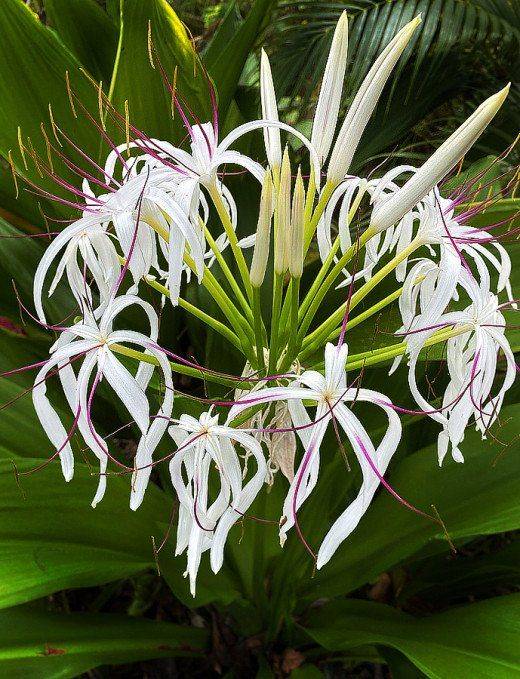

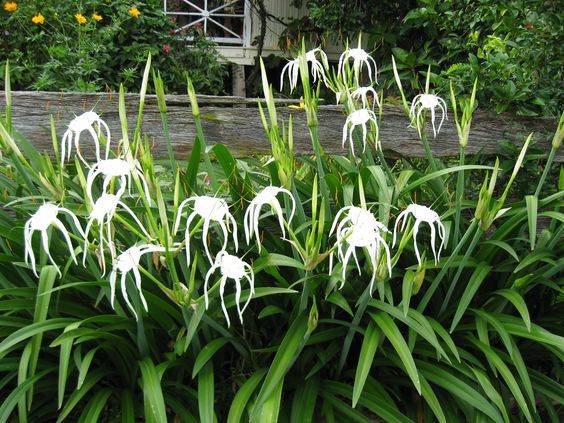
Crinum asiaticum (Spider lily or Seashore lily)

Crinum asiaticum, commonly known as poison bulb, giant crinum lily, grand crinum lily, or spider lily, is a bulb-forming perennial that produces an umbel of large, showy flowers that are prized by gardeners. The plant is native to Indian Ocean islands, East Asia, tropical Asia, Australia, and Pacific islands. It is regarded as naturalized in Mexico, the West Indies, Florida, Suriname, Louisiana, numerous Pacific islands, Madagascar, and the Chagos Archipelago. Crinum asiaticum is a perennial herb that typically grows up to 1.2 meters tall. It has a leaf base. Its pseudobulb is spherical. The upper part of the bulb is cylindrical. The base is laterally branched, with a diameter of about 6–15 cm. Its leaves are lanceolate, margin undulate, apically acuminate. They feature 1 sharp point and are dark green, growing up to 1 meter long. Their width is 7–12 cm or wider and they number 20-30. The inflorescence is an umbel with 10-24 flowers, six petaloid tepals, and aromatic. The flower stem is erect, as long as the leaf, and solid. The spathe is lanceolate, membranous, and 6–10 cm. The bractlet liner is 3–7 cm. Its perianth tube is slender and straight, green white, 7–10 cm long with a diameter of 1.5–2 mm. The corolla is spider-like shaped, white, linear, revolute, attenuate, 4.5–9 cm long and 6–9 mm wide. The corolla is 6-lobed. The pedicel is ca 0.5-2.5 cm long. It has six reddish stamens.
Light: Crinum asiaticum can do well in both sun and shade but if you want the best flowers, make sure it gets a minimum of 4-5 hours of mild morning sun daily.
Soil: The plant prefers well-draining, light and fertile soil that should be slightly acidic (pH 6.0 to 6.5) and should be amended with organic matter or compost prior to planting.
Water: Crinum asiaticum requires regular watering especially during hot and dry weather.
Temperature: It grows best in warm temperatures.
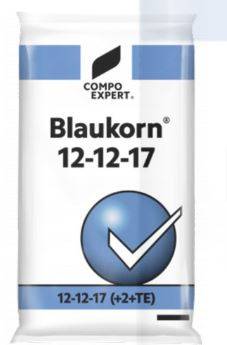
Fertilizer: Add fertilizer for blooming in the moment that the bulb starts to grow after blooming add fertilizer for growing leaves; it will make the bulb stronger.
Pests: Check your plant regularly for signs of infestation and treat with an insecticide if necessary.
Here are some step-by-step instructions for taking care of Crinum asiaticum:
Review
Related products























Contact Info
- Address: Love gardens LLC , nursery warsan 3, Dubai
- Phone: +971 554899462
- Email: [email protected]